Guide
What to use instead of gym equipment
The nearest gym may be forty minutes away, and the day has no room for the drive. The barn can do most of what a gym does: something to lift, something to step on, something to pull, something to hold on to.
- Uses
- buckets, bales, posts, feed sacks, a tire
- Answers
- What can I use instead of gym equipment?
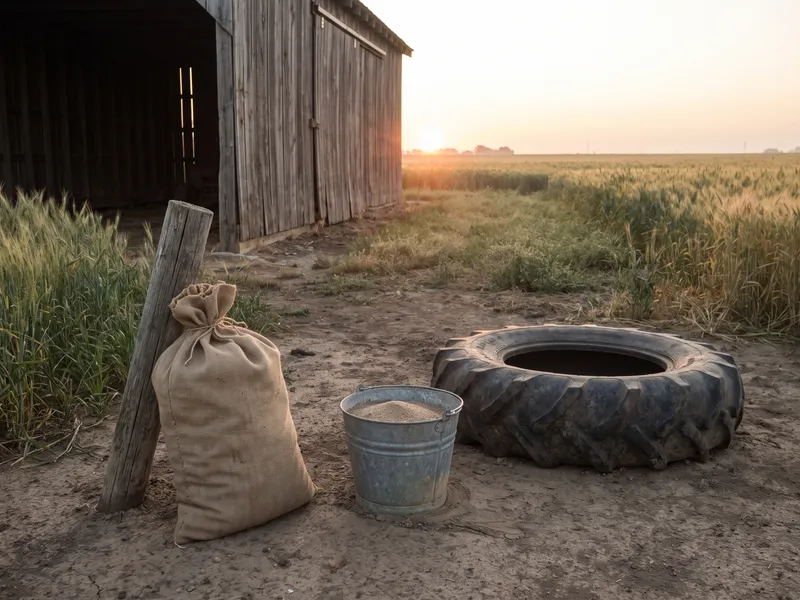
What each barn tool stands in for
- Buckets
- Stands in for: Dumbbells and kettlebells Fill with water, sand, or gravel to set the weight. Mark a fill line once you find one that works.
- Hay bales
- Stands in for: A box, a bench, and a sled Step on it, sit to it, push it across the yard. A small square bale is about the right height for step-ups.
- Fence posts and rails
- Stands in for: A balance bar and a rack Hold on for balance work, or lean on a rail for push-ups at an angle.
- Feed sacks
- Stands in for: A sandbag Awkward to hold, which is the point. Hug it, carry it on a shoulder, row it.
- An old tractor tire
- Stands in for: Heavy pushing and a sledge target For the stronger tiers. Flips are hard work and need good form.
- Your own body
- Stands in for: Most of the rest Split squats, push-ups, bridges, and balance need nothing at all. Dumbbells work fine too, if you have a pair.
How to load barn tools safely
- Start lighter than you think. A half bucket is plenty for the first week.
- Check handles and twine before you lift. A bucket handle that snaps mid-lift is how people get hurt.
- Keep the ground flat and dry where you train.
- Add weight a little at a time: a few more scoops of sand each week, not a full bucket.
Example: one barn-tool session, 25 minutes
An example only, not a plan matched to you. It fits on a working day: before chores, at lunch, or in the last of the light.
Loosen up
No equipment needed 5 minutes
Hip circles, arm swings, and a slow lap of the yard.
Bucket hinge
Uses: a bucket of sand 3 sets of 8
Hips back, flat back, stand up through the heels.
Bale step-up
Uses: a hay bale 3 sets of 6 a side
Step up slow, step down slower.
Feed-sack row
Uses: a feed sack, a bale to lean on 3 sets of 8 a side
One hand on the bale, pull the sack to your ribs, squeeze the shoulder blade.
Two-bucket carry
Uses: two buckets To the gate and back, 3 times
Even weight in each hand. Walk tall.
Fence-post balance
Uses: a fence post 2 holds of 30 seconds a side
Light fingers on the post, one foot up.
Train both sides
Carry and row with both hands. Farm work tends to load one side more than the other, and the shoulders and neck often feel it.
In a survey of 518 Midwest farmers, about 31% reported neck or shoulder pain in the previous two weeks.
Source: Fethke et al., 2015
That survey shows how common it is, not what causes it. Working both sides is a simple habit either way.
Contents
What the paid program adds
Full Strength is the hardest use of these tools: tire work, heavy carries, and loaded bale work, built up over 12 weeks, about 30 minutes a session. Foundation and Back in Shape use the same barn tools, lighter.
Full Strength: $79 one-time, 12 weeks. Or every tier with membership, $12 a month or $99 a year.
Caution Check with your doctor before you start. Results vary from person to person.