Guide
Do chores count as exercise?
Short answer: chores count for a lot. You are on your feet, lifting, carrying, and climbing most of the day. But chores repeat the same few motions, usually on the same side, and they skip a few things a body needs to keep doing this work for decades.
- Uses
- one bucket, a fence post
- Answers
- Do I need this if chores keep me moving all day? How much time does it take?
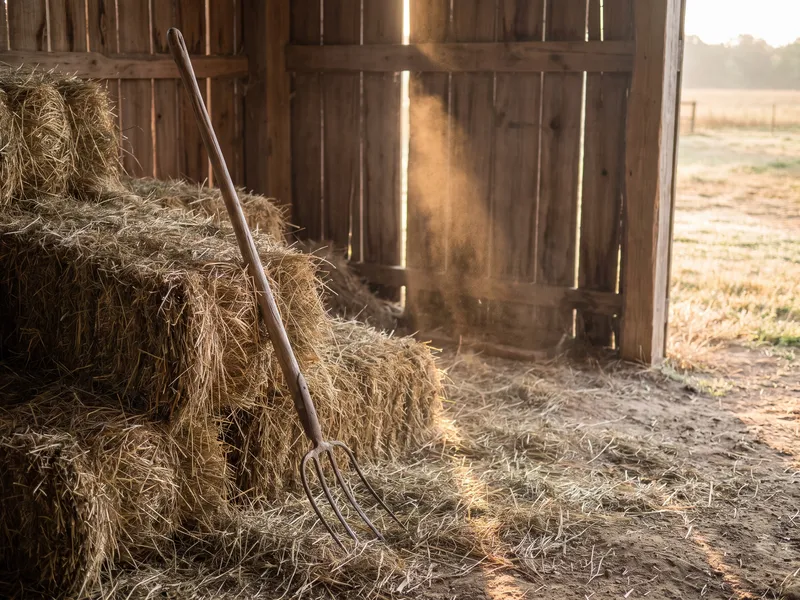
What chores already give you
Plenty. Walking fence lines, forking hay, and hauling feed build a kind of work capacity most desk workers never get near. You do not need a program to get you off the couch. If you are reading this, that was never the problem.
The narrower question is whether the movement you get is the movement your body needs.
What chores tend to miss
Farm work has a pattern: the same hand on the bucket, the same shoulder under the sack, the same bend at the waist a hundred times a morning. A few things get left out:
- The other side. If your right arm carries every bucket, the left side and the trunk do less of the work.
- Slow strength. Chores are mostly quick and repeated. Lifting something with control, slowly, through a full range is a different job for the muscles.
- Balance on purpose. You walk rough ground all day, but rarely stand still on one leg and hold it.
- A clean hinge. Most lifting on a farm happens with a rounded back because it is fastest. Practicing a hip hinge gives the back a better habit.
A review of 24 studies worldwide found about 48% of farmers reported low back pain in the past year, and 75% had it at some point in life.
Source: Osborne et al., 2012
That review shows how common back pain is among farmers, not what causes it. It is still a good reason to train the hips and trunk to share the lift.
Three moves to fill the gaps
Bucket hinge
Uses: one bucket, half full 2 sets of 8
Push your hips back like you are closing a truck door with your backside. Flat back, stand up through the heels.
Offside carry
Uses: one bucket To the gate and back, twice
Carry with the hand you never use. Walk tall and do not lean away from the bucket.
Fence-post balance
Uses: a fence post 3 holds of 20 seconds a side
Light fingers on the post, one foot up. Take the hand away when that gets easy.
How much time it takes on a working day
Less than morning feeding. Our sessions run 15 to 30 minutes, three or four days a week. That fits before chores, at lunch, or in the last of the light.
The easiest way to fit it in is to tie it to a chore you already do every day, with the tools still in hand. Feed the stock, then do your hinges with the empty bucket. Close the gate, then stand on one leg at the post. If it rides along with something that already happens, it gets done.
On a day of haying or calving, skip it. A missed session is not a failure. Pick it back up the next day.
The average US farm producer is 58.1 years old, and 38% of producers are 65 or older.
Source: USDA Census of Agriculture, 2022
A lot of people farm well into their sixties and past, and training that fits around the work is meant for them.
Contents
What the paid program adds
This guide gives you three moves. Back in Shape gives you 12 weeks of them in order: strength work aimed at muscle and bone, farm-tool resistance that goes up week to week, and sessions sized to about 25 minutes, three days a week.
Back in Shape: $69 one-time, 12 weeks. Or every tier with membership, $12 a month or $99 a year.
Caution Check with your doctor before you start. Results vary from person to person.