Guide
Staying steady around the barn and equipment
Most falls on a farm happen doing something ordinary: stepping off the tractor, crossing a wet floor, carrying something that blocks the view of your feet. Some of the fix is the barn. Some of it is balance and leg strength, which you can practice like anything else.
- Uses
- a fence post, a fence rail, a hay bale
- Answers
- How do I lower my risk of a fall around the barn and equipment?
Fix the places people fall
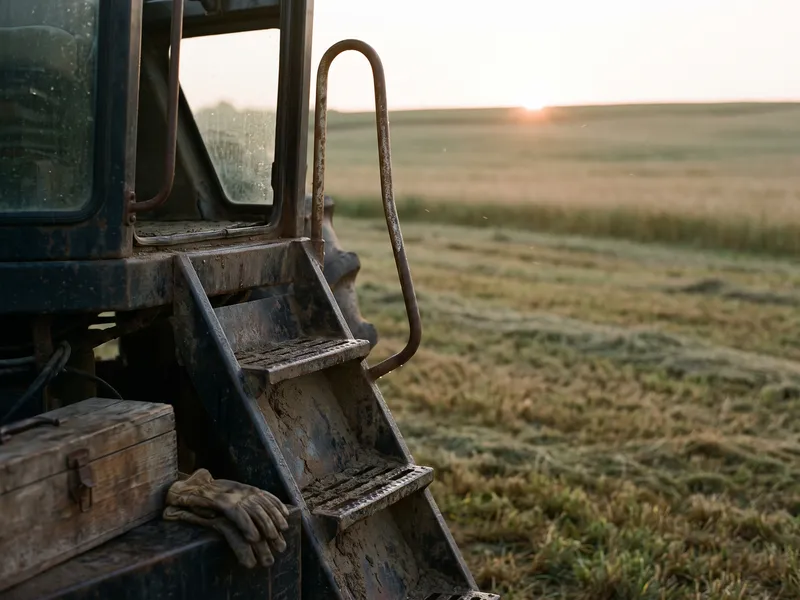
- Tractor and truck steps: face the machine, keep three points of contact, and climb down instead of jumping. Keep the treads clear of mud and ice.
- Light: put a light where you walk before sunup and after dark, and keep a headlamp in the truck.
- Floors: scrape and sand the wet and icy spots. Keep hoses, cords, and baling twine off the walkways.
- Ladders and lofts: set the ladder at a steady angle, tie it off if you can, and do not carry loads up it.
- Boots: good tread, laced snug. Worn-flat soles slip.
- Carrying: if the load blocks your view of your feet, make two trips.
- Hurry: most of us fall when we rush. The cows will wait another minute.
What the research says about balance
The US Preventive Services Task Force recommends exercise programs for adults 65 and older who are at higher risk of falling.
That recommendation is for adults 65 and older at higher risk. Balance and leg strength matter at any age, though, and they fade when nobody practices them.
Five balance moves for the fence post
Fence-post stand
Uses: a fence post 3 holds of 20 to 30 seconds a side
Fingertips on the post, lift one foot. Take the hand away when it gets easy.
Heel-to-toe walk
Uses: a fence line to walk beside 2 lengths of about 20 steps
One foot right in front of the other, like walking a rail. Eyes ahead, hand near the fence.
Heel raises
Uses: a fence rail 2 sets of 12
Rise up on your toes slow, lower slower. Strong calves help on rough ground.
Bale sit-to-stand
Uses: a hay bale 2 sets of 8
Stand up without your hands. The same legs get you up off the ground.
Getting up from the ground
Uses: a hay bale to lean on 3 times
Roll to your side, then to hands and knees, then half-kneel and push up with a hand on the bale. Practice it before you need it.
Do these with something solid in reach. The goal is to wobble a little and catch yourself, not to fall.
Medicines, eyes, and tired days
Some medicines can make you dizzy, and old glasses make step edges hard to judge. Ask your doctor or pharmacist about both at your next visit.
And on the long days, slow down near the end. Tired makes everyone clumsy.
Contents
What the paid program adds
Foundation puts balance first: single-leg work, getting up and down, and leg strength for steps and rough ground, built week by week over 12 weeks. Three 20-minute sessions a week, most of them in the yard.
Foundation: $49 one-time, 12 weeks. Or every tier with membership, $12 a month or $99 a year.
Caution Check with your doctor before you start. Results vary from person to person.